The DevSecOps and appsec market is full of options, but teams often choose the wrong one. The issue is usually structural, not about skill gaps. Most comparisons focus too much on SCA and dependency scanning. They miss the bigger architectural differences that decide if a tool helps or slows you down.
Teams have different needs. Some want one platform to cut tool sprawl. Others need runtime intelligence that shows real risks instead of theoretical alerts. A few prefer open-source flexibility or specialized web app testing.
We take a practical approach in our Snyk alternatives. We highlight platforms that stand out in coverage breadth, runtime capabilities, and developer workflow integration.
| Firm | Core Strengths | Security Coverage | Best For |
| Aikido | Unified DevSecOps platform | SAST, DAST, SCA, IaC, CSPM, containers, secrets, API & runtime security | Teams reducing tool sprawl |
| Black Duck | SCA, SAST, license compliance | Open-source dependencies, licenses, SAST, software supply chain security | Enterprises focused on governance and compliance |
| Oligo Security | Runtime-based risk prioritization | Runtime security, Runtime SCA, SBOMs, cloud workloads, AI security | Teams overwhelmed by vulnerability alerts |
| Jit | AI-powered security automation | SAST, SCA, cloud security, compliance automation, runtime context | DevSecOps teams seeking automated prioritization |
| FOSSA | Software supply chain and compliance management | SCA, license compliance, SBOMs, containers, dependency management | Organizations prioritizing compliance and SBOM management |
| Opengrep | Open-source SAST platform | Static code analysis, inter-procedural analysis, cross-file analysis | Teams prioritizing transparency and self-hosting |
Top 6 DevSecOps and Application Security Platforms
The six platforms listed below are useful Snyk alternatives for teams that need to balance money, operational complexity, and security coverage. Each was chosen based on its unique market positioning and practical adoption.
Black Duck
Black Duck remains a well-known name in application security and SCA. The platform makes it easier for organizations to identify open-source risks, manage licenses, assess code vulnerabilities, and maintain visibility over their software supply chain.
Unlike solutions built mainly for developers, Black Duck prioritizes governance and compliance at scale. It combines software composition analysis, static application security testing (SAST), vulnerability data, and policy management — all in one place — to help enterprises handle security and licensing risks without scattered tools.
Key Strengths
- Extensive open-source vulnerability intelligence
- Strong software composition analysis and license compliance
- Enterprise-grade governance and policy management
- Cloud and on-premises deployment options
Why Choose This Platform?
Black Duck is a strong choice for organizations that prioritize software supply chain security, compliance, and governance.
It is particularly valuable for enterprises managing large portfolios of applications with significant open-source usage, where vulnerability management and license compliance are equally important. Teams that need detailed audit trails, policy enforcement, and long-term visibility into software risk often find Black Duck a good fit.
Aikido
Aikido is one of the leading Snyk alternatives for organizations looking to reduce security tool sprawl by bringing multiple security capabilities into a single platform.
Instead of relying on separate solutions for application security testing, cloud security, dependency management, container security, and runtime protection, teams can manage these functions from one interface.
The platform combines SAST, DAST, SCA, Infrastructure as Code scanning, container security, Cloud Security Posture Management (CSPM), secret detection, API security testing, malware scanning, and runtime protection.
Its focus on consolidation, automated triage, and developer-friendly workflows helps teams manage vulnerabilities across the software development lifecycle while reducing operational complexity.
Key Strengths
- Unified platform for code, cloud, container, and runtime security
- Broad security coverage without relying on multiple products
- Built-in IaC scanning, CSPM, API security, and runtime protection
- Developer-focused workflows designed to reduce alert fatigue
Why Choose This Platform?
Aikido helps organizations simplify security by reducing the need for multiple tools. Teams often struggle when cloud infrastructure, containers, dependencies, and application security live on different platforms.
By combining strong coverage, easy onboarding, straightforward pricing, and reduced overhead, Aikido gives growing DevSecOps teams the comprehensive visibility they want — without making things more complicated.
Oligo Security

Oligo Security takes a runtime-first approach to help teams prioritize vulnerabilities based on real application behavior, not just static scan results. It analyzes what’s actively executing in production to surface only the reachable, exploitable risks.
With built-in Runtime Application Security, Runtime SCA, Cloud Workload Protection, SBOM generation, licensing tools, and AI security features all in one platform, Oligo makes it easier to cut through the noise. By tying runtime insights to vulnerability data, it reduces alert fatigue and directs remediation efforts toward the issues that truly impact production systems.
Key Strengths
- Runtime visibility into executing components and dependencies
- Runtime SCA and automated SBOM generation
- Cloud workload and application security context
- AI security monitoring capabilities
- Prioritization based on runtime activity
Why Choose This Platform?
If your organization is overwhelmed by vulnerability findings and short on remediation resources, consider Oligo Security. Its runtime-first method lets teams prioritize issues that are actually active in production, instead of everything static analysis turns up.
It’s particularly useful for microservices, cloud-native apps, and complex dependency environments where traditional scanners often create too much noise.
Jit
Jit takes a different approach to security. Its AI agents tap into a context graph that connects your cloud infrastructure, code repositories, runtime environment, identity systems, and data integrations. Rather than overwhelming teams with long lists of potential issues, it surfaces only the findings that are relevant to your actual environment.
This shift is important. It moves the focus from endless detection to practical remediation. Engineers get to see what really matters in their stack instead of theoretical CVEs that may never apply.
The platform combines code scanning, cloud security, data security, and compliance automation into a single interface. SAST and SCA checks are embedded where developers already work, so security feels like a natural part of the process.
Key Strengths
- AI agents connect findings across cloud, code, runtime, and identity layers
- The context graph cuts out over 90% of false positives
- Security checks happen where developers work, not in separate dashboards
- Built-in automation for SOC 2, ISO 27001, and PCI DSS
- One unified platform instead of multiple disconnected tools
Why Choose This Platform?
Jit tackles the constant flood of alerts that most security tools create. Instead of wasting hours triaging noise, teams can focus on actual problems.
Its agents connect the dots between code vulnerabilities, cloud permissions, runtime behavior, and data access. This bigger picture helps security move faster rather than slow things down.
It’s especially useful for growing teams that want to strengthen DevSecOps without adding more people.
FOSSA
FOSSA tackles the friction point most platforms ignore: making open-source compliance fast enough for continuous deployment. Its reachability-based analysis reduces false positives in dependency scanning, surfacing only vulnerabilities in code paths your application actually executes. This cuts noise dramatically. Teams ship faster without sacrificing audit-ready documentation.
The platform automates policy enforcement, vulnerability remediation, and SBOM generation in a single workflow. Container scanning with license attribution notices ensures every image meets both security and legal requirements before production. Developers stay in their IDE; legal gets real-time compliance reports. No context switching.
Where Snyk prioritizes vulnerability breadth, FOSSA optimizes for the compliance bottleneck. It’s built for organizations where open-source licensing, supply chain attestation, and regulatory audits create as much friction as security alerts themselves.
Key Strengths
- Automated license policy enforcement across all dependencies
- SBOM generation compliant with NTIA and SPDX standards
- Container image scanning with full attribution chain
- Integration with Jira, GitHub, and GitLab for remediation workflows
Why Choose This Platform?
Choose FOSSA when legal and compliance teams are blocking releases due to open-source uncertainty. Its automated policy engine turns license reviews from weeks-long bottlenecks into instant CI/CD gates.
The platform shines in regulated industries (finance, healthcare, government) where proving compliance is as critical as fixing CVEs. Reachability analysis means security teams focus on real threats, not theoretical ones.
Opengrep
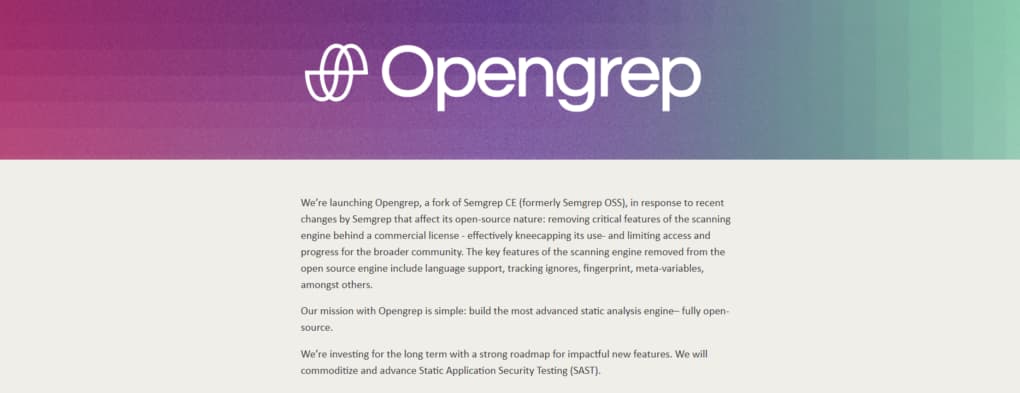
Backed by a consortium of 10+ appsec organizations, Opengrep is an open-source fork built to remove licensing barriers in SAST tools.
Essential features — inter-procedural and cross-file analysis, plus extended language support — ship in the base version. Teams get robust scanning without budget fights. It drops easily into existing pipelines with JSON/SARIF outputs and Windows support.
Commercial vendors often focus on breadth or runtime intelligence. Opengrep differentiates through openness, giving smaller teams the same depth enterprises pay for. Great for focused code analysis, though not a complete security suite.
Key Strengths
- Open-source governance model prevents vendor lock-in on critical features
- Inter-procedural and cross-file analysis included in base distribution
- SARIF and JSON outputs integrate with existing security workflows
- Windows support alongside Linux and macOS deployment options
Why Choose This Platform?
Pick Opengrep when you want reliable static analysis without ongoing vendor costs. It suits open-source projects, startups watching expenses, or larger teams that want to audit and extend their tooling independently.
What to Look for in a Snyk Alternative
Start by defining clear criteria that match your team’s day-to-day reality before comparing tools. Think about coverage first. Some platforms only scan dependencies, while others also handle code, running apps, containers, and cloud configs. Smaller teams usually prefer the broader approach.
Then look at how the tool sorts vulnerabilities. Old-school scanners overwhelm you with alerts. Good alternatives show whether a flaw is reachable, actually used in production, or truly exploitable. That kind of intelligence keeps teams focused on real threats.
Don’t forget workflow fit. Native integrations with your Git provider, Jira, Slack, and IDEs make a big difference. And be upfront about pricing. Transparent, usage-based models without surprise upsells or locked features save a lot of hassle later.
Conclusion
Choosing Snyk Alternatives starts with your team’s actual problems, not just feature lists. If tool sprawl and multiple vendors are an issue, look for a platform that consolidates everything and reduces context switching.
Teams buried in false positives need runtime intelligence that shows which findings are truly exploitable. Enterprises handling audits and license risks want strong compliance features alongside vulnerability detection.
Budget-focused or open-source teams often prefer transparent, vendor-neutral tools. Run a quick proof of concept on one or two options that match your top priority. Check integration with your CI/CD pipelines, developer workflows, and reporting. Only commit long-term once you see it lowers risk without slowing development.
The best tool is the one your team will actually use.