
As a fintech CTO, you need Open Banking infrastructure that actually delivers. Bank data connectivity and payment workflows should be evaluated against each provider’s implementation scope, onboarding process, and technical requirements. Payment initiation that survives SCA changes. Verification flows that won’t force another integration in six months.
Pick the wrong provider, and you’ll burn engineering time plus delay your launch.
Open Banking has come a long way since PSD2, but the platforms still differ in important ways. Some offer deep UK coverage with excellent bank penetration, while others focus on broad pan-European reach. A few stand out for transaction enrichment or instant payouts.
These differences become critical when you’re building Pay by Bank checkouts, embedded finance solutions, or operational financial workflows — where data quality and payment success rates directly impact revenue.
How to Evaluate Open Banking API Providers
Choosing the right Open Banking provider comes down to matching their strengths with your actual needs. Here are the most important factors to consider:
- Bank reach: UK specialists usually deliver deeper coverage and faster data on local banks. Broader providers connect to thousands of banks across Europe.
- Payment initiation reliability: Prioritise proven success rates and strong SCA handling.
- Data accuracy: Especially important for reconciliation, operational finance, and transaction categorisation workflows
- Compliance model: Faster route via their licence, or slower but more independent with your own authorisation.
- Pricing: Compare per-transaction costs, volume discounts, and what exactly gets charged.
- Integration ease: Prefer unified APIs that combine everything over fragmented setups.
Review these points against your timeline and technical requirements first.
Leading Open Banking APIs for Payment Infrastructure
The right open banking provider balances UX, security, and coverage. Below, we compare leading platforms—what they do best and where they don’t.
1. TrueLayer
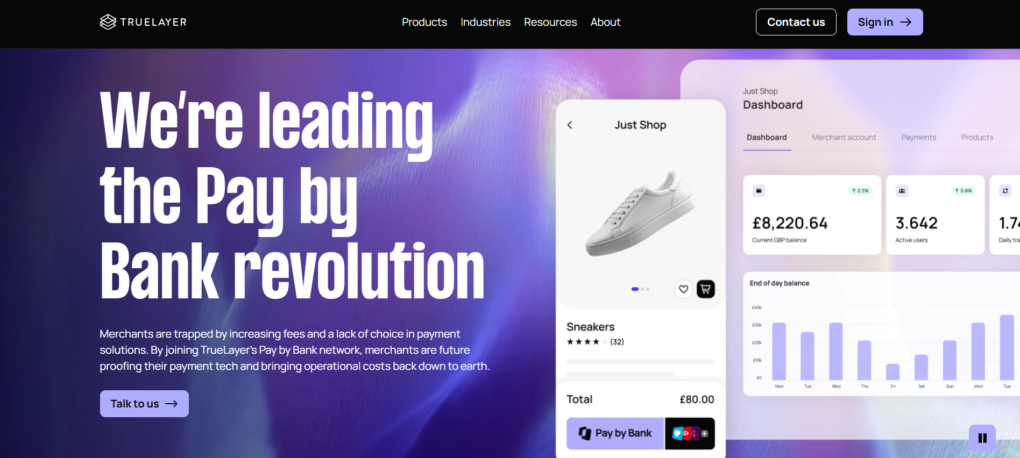
Since its founding in 2016, TrueLayer has developed one of the leading Pay by Bank networks in Europe.
The company now accounts for nearly 50% of the entire UK market and handles well over twice the daily payment volume of its nearest competitors. Its network includes more than 20 million users and grows by roughly 1 million new users each month.
This level of adoption and proven performance gives businesses confidence when payment success rates are critical to revenue. TrueLayer is fully authorised and regulated by the UK Financial Conduct Authority, so it manages all PSD2 compliance requirements on your behalf.
Core capabilities include:
- Pay by Bank payments — instant checkout experiences without relying on cards.
- Payouts — quick bulk disbursements straight to bank accounts.
- Bank on File — secure stored credentials for recurring use.
- Data API — real-time access to transactions and balances.
- Verification — robust identity and account ownership checks.
- Signup+ — faster customer onboarding with pre-filled information.
1. Finexer
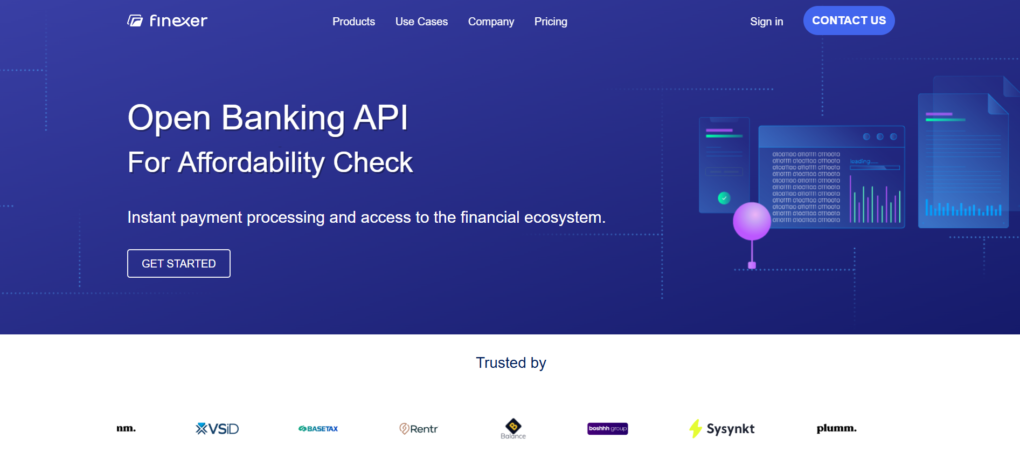
Finexer enables businesses to access clients’ bank accounts and initiate payments on their behalf, without the headache of PSD2 compliance and spending much time on coding.
Launched in 2019, the platform targets scaling SaaS businesses that need solid bank connectivity in a short time. It provides excellent 99% UK bank coverage together with real-time financial data. One clean, unified API handles both AIS and PIS, reducing maintenance as rules like SCA evolve.
Its main differentiator is a modern Bank-to-Bank solution built on the latest Open Banking standards. This supports UK-focused Open Banking workflows through bank connectivity, Pay by Bank payments, payout coordination, and operational finance infrastructure.Well suited for teams building embedded finance and operational finance workflows that want to reduce integration complexity.
Key capabilities:
| Feature | Scope |
| Bank Transactional Data | Real-time transaction feeds |
| Instant Payments | Pay by Bank initiation |
| Batch Payouts | Bulk disbursement processing |
| Identity Verification | Account ownership checks |
The startup tier offers discounted pricing, a white-label solution, and unlimited Finexer accounts. The standard tier provides standard pricing with the same white label and dashboard access, while the Enterprise tier uses volume-based pricing with account management and customized setup. No setup fees, no hidden fees, no cancellation fees.
3. Bud Financial
Bud Financial, founded in 2015, focuses on turning raw bank transactions into highly accurate, usable data. With 98% enrichment accuracy powered by sophisticated AI and machine learning, it helps businesses deliver personalised banking experiences effectively.
What sets Bud apart is its sharp focus on data quality rather than payment infrastructure. This focus makes it a strong choice for lending, personal finance management, and risk assessment applications where reliable transaction intelligence is critical.
The platform organises messy bank feeds into clear, categorised information with proper merchant details. Lending platforms and neobanks particularly benefit from reduced underwriting errors and improved customer transaction visibility.
Core capabilities:
- Transaction enrichment — categorisation and merchant identification.
- AI-powered transaction search — natural language query handling.
- Customer segmentation — spending behaviour clustering.
- Lending and credit risk assessment — income/expense verification.
- Merchant categorization — standardised taxonomy mapping.
4. Salt Edge
Since 2013, Salt Edge has developed one of the broadest Open Banking networks available, linking to 5,000+ financial institutions across 50+ countries. It’s especially useful for businesses operating in multiple markets or handling cross-border flows.
What many companies appreciate most is the flexible licensing approach. Salt Edge allows you to innovate and launch without acquiring your own PSD2 licence or certificates — you simply use theirs. This can shave considerable time off your go-to-market timeline.
The platform maintains strong security credentials, including ISO 27001 certification, and manages the regulatory overhead so you can concentrate on building great customer experiences.
| Feature | Coverage |
| Data aggregation | 5,000+ banks |
| Payment initiation | Cross-border PIS |
| Customer onboarding & KYC | Identity verification |
| Real-time bank data access | AIS with live feeds |
5. Volt
Founded in 2017, Volt stands out by connecting thousands of banks and real-time payment schemes across multiple countries. This unified infrastructure lets businesses handle Pay by Bank transactions, payouts, refunds, and virtual account services without the usual complexity of different local systems.
The platform taps directly into domestic instant payment rails worldwide, helping companies reduce their reliance on card networks. It reaches hundreds of millions of bank accounts globally and works particularly well for businesses that need fast settlement.
Key capabilities:
- Instant Payments — real-time Pay by Bank checkout.
- Refunds — fast reversal processing.
- Payouts — bulk disbursements to customer accounts.
- Volt Accounts — virtual IBANs for easier collection.
- Payment verification — built-in fraud protection.
It’s a strong fit for e-commerce, crypto, iGaming, retail, and wealthtech companies operating across borders.
6. Brite Payments

Brite Payments delivers smarter instant payment solutions powered by its own Instant Payments Network. Connecting more than 3,800 European banks and operating 24/7/365, it achieves near-zero fraud and chargebacks while eliminating card network fees and cut-off times.
As a regulated Swedish Payment Institution (founded in 2019), Brite provides PSD2-compliant Open Banking across Europe. Consumers authenticate and pay straight from their bank accounts with minimal friction — no apps or manual input required.
The platform supports instant payments, instant payouts, account verification, balance checks, and rich transaction data. It works especially well for iGaming, crypto, and subscription businesses that need fast, reliable settlement.
Core products:
| Product | Use case |
| Instant Payments | Real-time checkout flows |
| Instant Payouts | Same-day disbursements |
| Account Verification | Ownership confirmation |
| Income Insights | Affordability assessment |
7. GoCardless
Founded in 2011, GoCardless specialises in recurring Direct Debit and subscription billing workflows rather than instant Pay by Bank checkout flows.
The platform supports automated payment retries, payment tracking, reconciliation, and integrations with over 350 accounting, ecommerce, and business software systems — making it a strong fit for subscription businesses, membership organisations, utilities, and SaaS companies that prioritise reliable recurring revenue collection over instant payment finality.
GoCardless provides solutions for instant Pay by Bank payments, recurring Direct Debit collections, subscription billing, invoicing, and international bank payments across more than 30 countries. The platform is authorised and regulated by the UK Financial Conduct Authority under the Payment Services Regulations, handling compliance overhead for clients operating Direct Debit schemes in multiple jurisdictions.
Pros:
- 350+ software integrations (accounting, CRM, invoicing);
- Automated retry logic for failed Direct Debit collections;
- 30+ country coverage for recurring payments.
8. Trustly
Trustly has been running a large-scale Open Banking payment network since 2008. It connects thousands of merchants with hundreds of millions of consumers across multiple markets.
Its real edge comes from the Trustly Azura engine — a data-driven system that personalises checkout experiences, speeds up payment flows, and boosts conversion rates. This directly tackles the friction that often leads to cart abandonment in e-commerce and digital services.
What the platform offers:
- Instant bank transfers (real-time A2A payments);
- Automated recurring payments for subscriptions;
- Customer verification and onboarding (KYC);
- Cross-border payouts for international disbursements.
Trustly handles the full payment process end-to-end. You can integrate directly via API or plug in through major PSPs, making it flexible for both large custom stacks and smaller merchants.
FAQ
Q: How much does Open Banking API integration cost in 2026?
A: Costs vary by scale and model. Most providers use usage-based pricing per transaction, typically £0.01–£0.50 depending on volume. You’ll often find no setup fees and flexible tiers that work well for both startups and larger companies.
Q: Do I need my own PSD2 licence?
A: Not usually. Providers let you build under their regulatory authorisation, which saves considerable time. Businesses with specific needs may still apply for their own.
Q: How long does integration normally take?
A: Standard payment flows can be ready in 2–4 weeks. Complex implementations involving several markets or custom features often stretch to 6–12 weeks.
Q: UK-focused or pan-European — which is better?
A: Choose based on your audience. UK-centric platforms generally give deeper local coverage and performance. Pan-European options suit businesses operating across multiple countries.
Q: What’s the real difference between Pay by Bank and Direct Debit?
A: Pay by Bank is instant — the customer authorises, and funds move in real time. Direct Debit works on a schedule with slower settlement, making it ideal for subscriptions where reliability and retries are key.
Conclusion
Selecting the right Open Banking API provider requires matching your specific use case, geographic footprint, and technical resources against each platform’s strengths. Before committing, map your customer distribution against bank coverage, test payment success rates in sandbox environments, and request pricing documentation upfront.
The wrong choice means rebuilding your payment layer; the right choice means you never think about bank connectivity again.