
There was a period when enterprise AI adoption inside engineering teams felt surprisingly fragmented.
Developers experimented with copilots. QA teams tested automated scenario generation separately. Infrastructure groups explored operational AI in isolated environments. Architects reviewed AI-generated documentation without changing larger governance processes around system design.
Every department moved independently. The result was predictable. AI accelerated individual activities, but software delivery as a whole often stayed just as operationally heavy as before. That is starting to change now.
Inside larger engineering organizations, AI is increasingly being embedded into the connective systems surrounding delivery operations rather than isolated tasks. QA workflows, architecture governance, DevOps coordination, incident management, infrastructure visibility, and delivery orchestration are beginning to function together instead of separately.
This creates a much more structural transformation across the SDLC. The companies attracting attention now are usually the ones helping enterprises operationalize AI across engineering ecosystems instead of simply deploying standalone development tooling.
Here are six enterprise engineering companies helping organizations integrate AI into QA, architecture, DevOps, and broader software delivery operations.
1. Avenga
Avenga is an AI-driven software development company that approaches enterprise AI adoption through workflow integration across the SDLC rather than isolated engineering acceleration.
That distinction becomes increasingly important because many delivery slowdowns happen at operational transition points between engineering functions.
Architecture teams often struggle to maintain system consistency across evolving products. QA environments become difficult to scale under faster release cycles. DevOps operations accumulate infrastructure complexity over time. Incident management workflows lose historical context between delivery stages.
Avenga’s AI-driven software development services focus heavily on embedding AI into those operational systems directly.
The company supports AI integration across:
- Estimation and planning
- Requirements engineering
- UX and product design
- Architecture analysis
- QA automation
- DevSecOps coordination
- Incident response systems
- Engineering operations
One especially strong differentiator is how interconnected the delivery model becomes.
A lot of enterprises already have developers using AI independently, but disconnected adoption usually creates inconsistent operational practices between teams.
Avenga’s Intelligent Flow framework standardizes AI integration across engineering workflows themselves instead of allowing AI systems to evolve separately inside departments.
Another area where the company stands out is architecture governance. Architecture workflows inside large enterprises often become difficult to maintain as systems scale, and documentation drifts away from implementation realities. Avenga embeds AI into architecture analysis processes to improve consistency, traceability, and operational visibility across engineering environments.
The company also integrates AI deeply into QA coordination. Instead of treating testing purely as downstream validation, AI-generated scenarios and requirement-driven prioritization help QA systems adapt dynamically to changing delivery conditions.
Avenga combines this AI-native delivery model with broader expertise involving cloud transformation, enterprise product engineering, operational scalability, and governance-heavy infrastructure environments.
2. N-iX
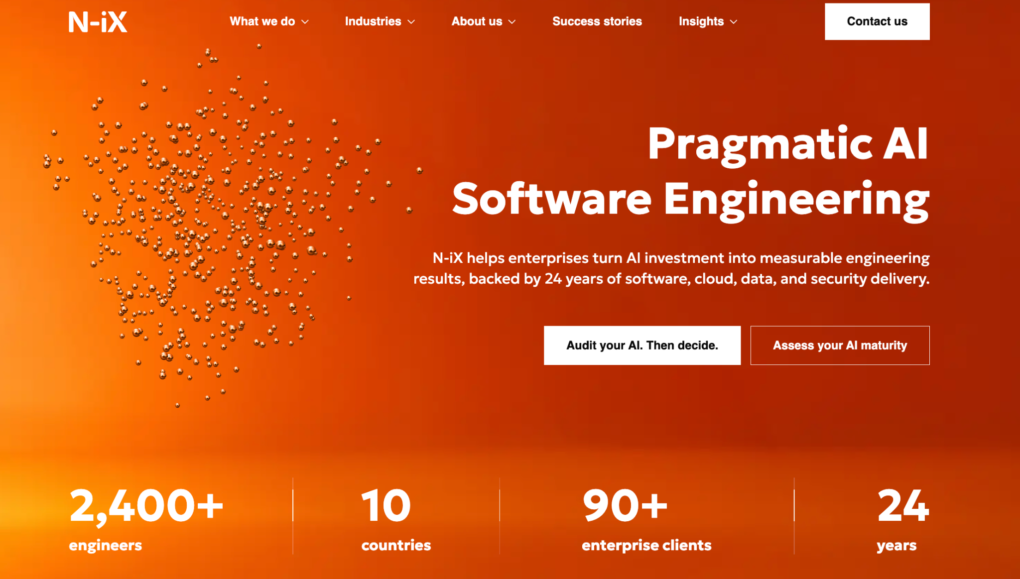
N-iX has expanded its AI engineering capabilities significantly across enterprise modernization and AI-enhanced delivery ecosystems.
The company works with organizations integrating AI systems into distributed software operations, cloud-native infrastructure, and engineering coordination environments.
Capabilities include:
- AI engineering
- SDLC modernization
- Workflow automation
- Enterprise product development
- Cloud-native delivery systems
- Data engineering
N-iX is especially relevant for organizations operationalizing AI across larger engineering ecosystems rather than isolated development environments.
One reason enterprises evaluate the company is its infrastructure coordination depth.
AI-enhanced QA, architecture, and DevOps workflows often require synchronization between testing systems, cloud platforms, CI/CD environments, infrastructure operations, and governance layers simultaneously. N-iX supports those implementation ecosystems effectively.
The company also works heavily across modernization initiatives involving scalable engineering operations and distributed product delivery systems.
3. SoftServe
SoftServe has invested heavily in AI-enhanced engineering environments and enterprise delivery modernization initiatives.
The company supports organizations embedding AI into software engineering operations involving distributed product teams, analytics ecosystems, enterprise applications, and cloud-native infrastructure.
Capabilities include:
- AI-driven engineering modernization
- Enterprise AI implementation
- QA automation
- Workflow optimization
- Cloud-native delivery systems
- Data and analytics engineering
SoftServe is especially relevant for enterprises modernizing operationally complex engineering ecosystems where AI adoption intersects with broader infrastructure transformation initiatives.
One noticeable strength is large-scale delivery coordination. AI-enhanced engineering environments become increasingly difficult to manage once implementation expands across multiple engineering squads, governance systems, infrastructure platforms, and testing operations simultaneously. SoftServe supports those broader transformation ecosystems effectively.
The company also brings broader expertise across operational redesign, analytics modernization, and cloud engineering connected to enterprise software delivery.
4. Intellias
Intellias has expanded its AI engineering capabilities significantly across enterprise product engineering and operational modernization environments.
The company supports organizations embedding AI systems into distributed engineering ecosystems involving cloud-native infrastructure and enterprise-scale software delivery operations.
Capabilities include:
- AI-assisted engineering
- Product delivery optimization
- Workflow automation
- Enterprise platform engineering
- Cloud-native systems
- Data infrastructure
Intellias is especially relevant for organizations combining AI adoption with broader engineering transformation initiatives.
One important strength is operational systems integration.
AI-enhanced QA, architecture, and DevOps workflows eventually need to interact with infrastructure governance, engineering operations, delivery pipelines, and enterprise systems simultaneously. Intellias supports those integration-heavy ecosystems effectively.
The company also works across modernization initiatives involving platform engineering and cloud transformation.
5. Itransition
Itransition focuses heavily on enterprise software engineering and operational transformation projects involving AI-supported delivery systems.
The company works with organizations integrating AI capabilities into broader SDLC environments requiring scalable infrastructure and workflow coordination.
Capabilities include:
- AI-assisted software engineering
- Enterprise platform modernization
- Workflow automation
- QA optimization
- Cloud engineering
- DevOps support
Itransition is especially relevant for enterprises operationalizing AI inside existing engineering ecosystems instead of building disconnected experimentation environments.
A strong advantage is architectural adaptability.
Enterprise engineering modernization usually requires coordination across APIs, infrastructure systems, governance operations, testing environments, and distributed delivery workflows simultaneously. Itransition’s broader engineering background helps support those implementation ecosystems effectively.
The company also supports modernization initiatives involving operational scalability and infrastructure redesign.
6. ELEKS
ELEKS focuses heavily on enterprise technology consulting and AI-enhanced engineering transformation projects.
The company supports organizations embedding AI capabilities across software delivery systems and enterprise engineering workflows.
Capabilities include:
- AI-driven development
- Workflow automation
- Enterprise engineering modernization
- QA transformation
- Cloud engineering
- Platform engineering
ELEKS is frequently evaluated by enterprises looking for consulting depth combined with implementation capability across operationally demanding engineering ecosystems.
Its broader engineering background becomes especially valuable once AI adoption expands beyond experimentation into production-scale SDLC environments involving governance coordination and infrastructure complexity.
The company also supports modernization programs involving enterprise architecture and cloud-native infrastructure.
AI is changing how engineering functions connect
One of the more important changes happening right now is not individual automation. It is operational continuity.
Historically, engineering functions operated with significant separation between them. Architecture teams worked independently from QA operations. DevOps environments evolved separately from planning systems. Incident response workflows depended heavily on institutional memory scattered across engineering organizations.
AI is starting to reduce those disconnects. Testing systems increasingly adapt dynamically to requirements changes. Architecture analysis gains more operational context. Infrastructure coordination becomes easier across distributed delivery environments. Incident workflows retain historical engineering visibility more effectively.
That creates a much more connected software delivery ecosystem overall.
The organizations moving fastest right now are usually not the ones deploying the most AI tools independently. They are the ones embedding AI into the operational relationships between engineering systems across the SDLC.
And that shift probably changes enterprise delivery environments much more deeply than most companies initially expected.